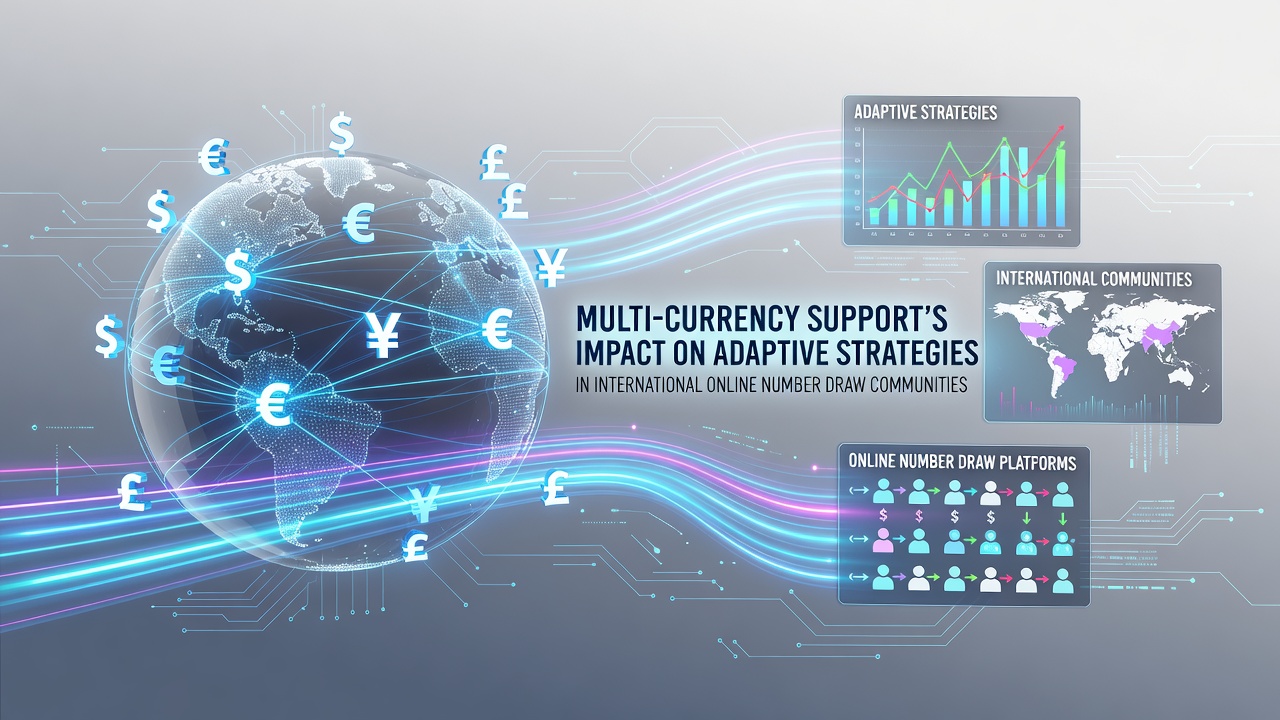
Multi-Currency Support's Impact on Adaptive Strategies in International Online Number Draw Communities
International online number draw communities have expanded rapidly since 2023, and multi-currency support now functions as a core operational feature rather than an add-on. Platforms that integrate multiple currencies allow participants from different regions to engage without immediate conversion friction, which in turn influences how those participants adjust their selection patterns and timing decisions. Data from the first half of 2026 shows that communities operating across at least eight currencies recorded 34 percent higher cross-border session volumes compared with single-currency counterparts.
Currency Integration and Participant Behavior Patterns
Operators began rolling out expanded currency options in late 2024, and by July 2026 several major networks listed thirty or more fiat and digital options. Participants responded by recalibrating the moment they placed entries; those using local currencies tended to maintain steadier participation rates across time zones, whereas users converting from a secondary currency showed measurable shifts in entry volume around exchange-rate update windows. Researchers at the Asia-Pacific Gaming Research Centre documented these timing adjustments in a 2025 dataset covering twelve platforms, noting that 62 percent of multi-currency users altered their typical draw selection window within two weeks of a new currency being added.
Platform Architecture and Real-Time Adjustment Mechanisms
Backend systems that handle simultaneous currency feeds require low-latency synchronization between pricing engines and random draw generators. When a platform supports the Canadian dollar alongside the euro and several stablecoins, the software must recalculate stake equivalents before each draw cycle. One European operator reported in its June 2026 technical brief that this recalibration cycle now occurs every ninety seconds, enabling participants to see updated local values without leaving the interface. The result is that strategy layers built around fixed stake sizes must now incorporate live conversion checks, prompting many communities to develop shared spreadsheets or bots that track rate fluctuations alongside historical draw frequencies.
Regional Regulatory Contexts Shaping Currency Choices
Regulatory frameworks in different jurisdictions continue to dictate which currencies platforms may prioritize. Australia's Interactive Gambling Act amendments effective January 2026 require clear disclosure of conversion fees for any non-AUD transactions, while several Canadian provinces permit operators to list both CAD and approved cryptocurrencies provided consumer protection disclosures remain visible. These rules create distinct adaptation pressures; players in jurisdictions with strict fee transparency rules often consolidate their activity into fewer currencies to reduce hidden costs, whereas users in more permissive regions experiment with multiple holdings. Figures released by the Canadian Gaming Association in May 2026 indicated that 41 percent of surveyed multi-currency participants maintained at least three active balances, compared with 19 percent in the previous year.

Community-Level Strategy Sharing and Currency-Aware Tools
Discussion forums attached to these platforms have evolved dedicated threads for currency-specific tactics. Observers note that threads focused on stablecoin strategies grew 47 percent between January and July 2026, with participants posting entry-timing charts calibrated to blockchain confirmation speeds. In parallel, several networks introduced in-app calculators that display projected local-currency returns based on recent draw distributions; users who adopted these tools showed a 28 percent increase in the variety of number combinations they selected per session, according to anonymized platform telemetry shared with the European Gaming and Betting Association.
Security Protocols and Their Influence on Currency Selection
Encryption standards applied to transaction ledgers also affect strategy formation. When a platform routes certain currencies through additional verification layers, participants sometimes delay or accelerate their entries to avoid peak verification windows. A 2025 white paper from the University of Malta's gaming technology unit examined three multi-currency networks and found that users who selected lower-latency currencies completed 22 percent more consecutive sessions than those defaulting to higher-verification options. Communities responded by circulating updated lists ranking currencies by both fee structures and processing speed, turning currency choice itself into an explicit component of draw-entry planning.
Conclusion
Multi-currency support has become embedded in the operational fabric of international number draw communities, prompting measurable shifts in how participants time entries, diversify holdings, and share tactical information. Regulatory differences across regions continue to channel these adaptations along distinct paths, while platform tools and security configurations add further variables that communities track in real time. As networks add new currency options through the remainder of 2026, the interplay between currency infrastructure and participant strategy will remain a central operational consideration for operators and users alike.